

Does Social Media Actually Work for Loan Officers?
By Dino Katsiametis, Founder & CEO, Ethos Lending · Host, The Way Podcast
Yes — but not the way most advisors are using it, and not on the timeline they expect.
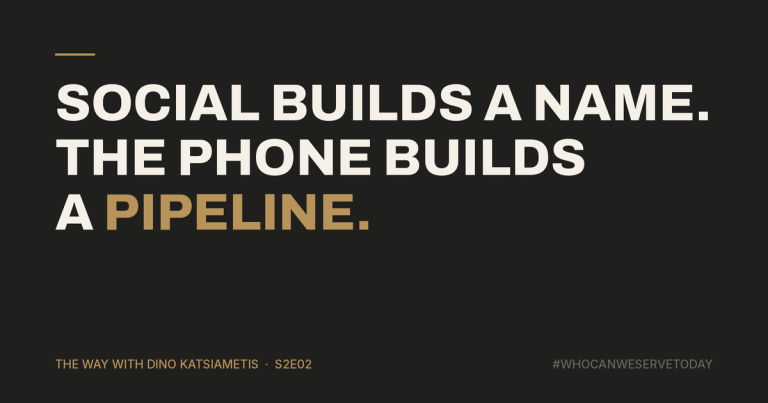
Wade Betz splits his working week eighty percent phone and face to face, twenty percent social. He is not anti-social-media. He posts constantly and he has built a real audience doing it. He is simply clear about what each half is for. Social builds recognition. The phone builds a pipeline. Short content makes people know your name. Long content makes you findable years later. Those are four different jobs and most advisors are trying to do all four with a single reel.
He said it more plainly than that on the show: people want social media to be an immediate return on investment, and it is not.
Why does most social media effort produce so little business?
Because it is being asked to do a job it was never good at.
Wade’s description of what short content actually produces is honest to the point of being unflattering. Branding. General awareness. Some business. Not the pipeline. Not the calendar. Some.
That is not a small return. It is just a different return than the one people are counting on when they spend a Sunday afternoon on a carousel post. Nobody watches a thirty second video and calls a lender that afternoon. What happens is much slower and much less satisfying to measure — your name stops being unfamiliar. Then a year later somebody’s sister asks who they should call, and yours is the only name in the room that anyone recognises.
Recognition is worth having. It is not worth eighty percent of a week.
What is the eighty percent actually spent on?
Calls and meetings, on a schedule, with a list made in advance.
The detail in Wade’s version that I would not have guessed is the Sunday evening. Before the week starts, he reviews the one that just ended and previews the one about to start, and he makes sure every call list is built and sitting there. Not the topics. The actual names.
His observation about it is the useful part: the weeks he skips the Sunday review are visibly worse. Not because he forgets what to do, but because Monday morning starts with the question of who to call, and answering that question at nine in the morning costs more than answering it on Sunday night.
He put it as a chain. Win the day by noon. Win the week by winning Monday. And Monday only works if Sunday did.
The best part of his standard is that it is not perfectionist. Three days out of five wins the week. Three weeks out of four wins the month. Nine months out of twelve wins the year. That is a target a real person can hit while having a life, which is exactly why he has hit it for a decade and most people abandon their systems in March.
So when is content worth the time?
When it is long, and when you are prepared to wait years rather than weeks.
Wade has been posting two long-form videos a week on YouTube for about two years. He now shows up in the top three on Google for his market — and he was careful on camera to say that could change, which is the kind of hedge that makes me trust the rest of it.
He also does something with those videos that most people skip. He takes the transcript, turns it into a written article, and publishes that too. One recording becomes a video, an article, and a set of clips. The video gets watched. The article gets found. The clips get remembered.
His stated goal is at least forty-five posts a week across all his platforms, which sounds impossible until you realise most of them are the same handful of recordings wearing different clothes.
And then the honest part. He has friends five and six years into the same habit who are far ahead of him — one of them did over thirty million dollars of business from a YouTube channel last year. Wade said out loud that he is not above being jealous of it. What separates him from the people who complain about the same gap is that he is still filming.
Which should a newer advisor pick?
The phone. It is not close.
If you have been in the business under three years, the honest answer is that content will not save you and calls might. A search result you start building today pays you in year three. Rent is due in thirty days.
The version of this I would give a new advisor is to run both, on Wade’s split. Eighty percent of your week on the phone and in front of people, because that is what produces income this quarter. Twenty percent on content, because that is what produces income in year three, and year three arrives whether or not you planted anything for it.
Drew Gillett made a version of the same argument on this show from the marketing side, and his framing of what consistent local presence actually compounds into is worth reading alongside this: The Social Media Mayor.
Where does the compounding actually happen?
Behind you, not in front of you.
This is the part I would push back on if the conversation stopped at content strategy. Wade closes about sixty-five percent of his business each year with people he has already worked with. That number is not the result of his posting schedule. It is the result of what he does after a file funds — the calls, the timing, and one meeting a year that almost nobody offers.
Content brought in a share of the strangers. The system kept everyone else from leaving. If you only have the bandwidth to build one of the two this year, build the second one, because it works on a database you already paid to acquire.
That system is written up in full here: Impossible to Forget.
The short version
- Eighty percent phone and face to face. Twenty percent content. Wade’s split, and it has held for years.
- Short content builds recognition. Long content builds a search result. Neither builds a pipeline this month.
- Make the call list on Sunday. Monday sets the week and Monday cannot start with a question.
- Three days out of five wins the week. Consistency beats intensity because it survives a bad month.
- One recording should become a video, an article and several clips. Filming once and publishing once is the actual waste.
- The compounding is in the database behind you, not the audience in front of you.
Based on a conversation with Wade Betz, Chief Strategy Officer at Mpire Financial, on The Way with Dino Katsiametis.
Views expressed are the individual’s own and do not represent their employer.
Watch the full episode on YouTube: The Way with Dino Katsiametis
#WhoCanWeServeToday