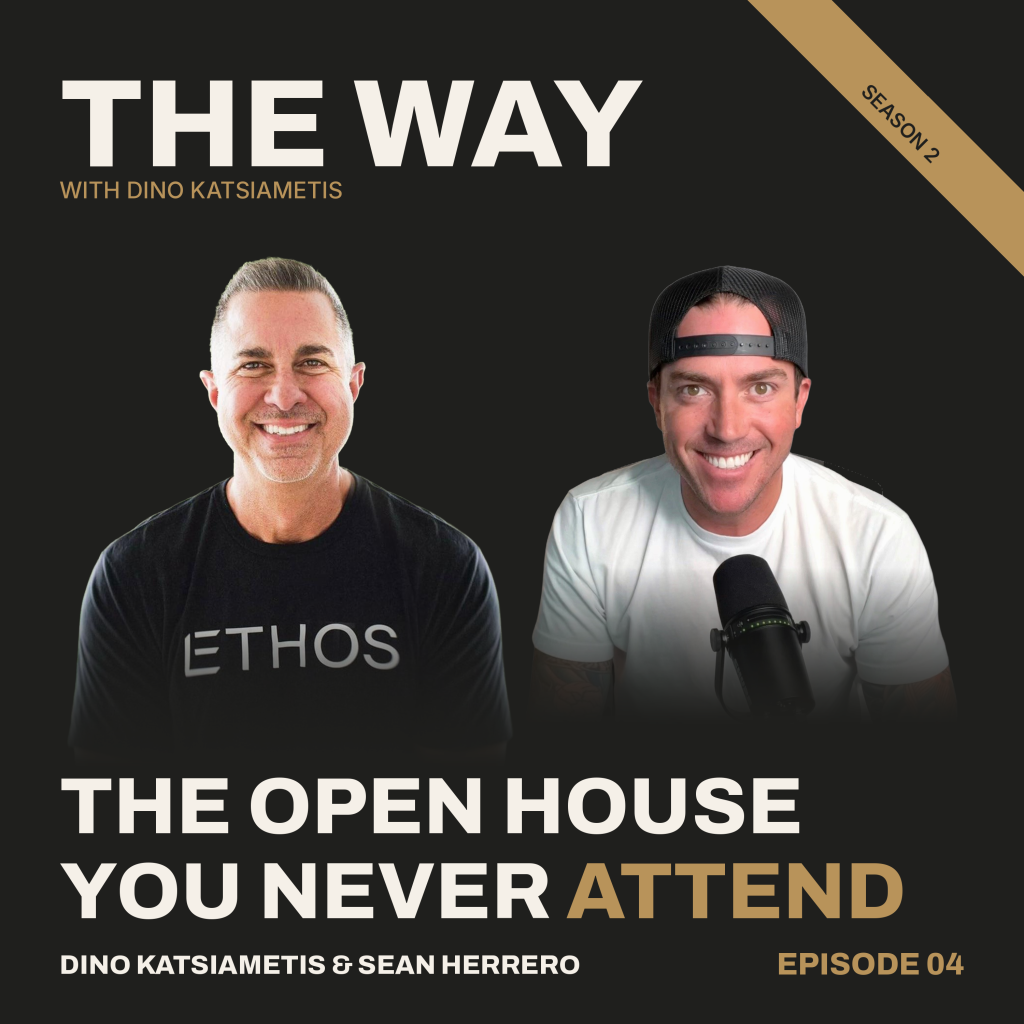
The Open House You Never Attend — Sean Herrero
With – Sean Herrero, Regional Vice President, CrossCountry Mortgage
Sean Herrero funded $220 million in 2021 and closed thirty units for $30 million in a single month this year — with a processor and nobody else. He is the first returning guest in the history of The Way, and he came back with the most stealable system of Season 2: an open house engagement kit he never attends.
The premise is that contact information is a transaction. If you want something of value, you have to trade something of value — and a flyer with photos, bed and bath count and a rate quote was on the internet before the buyer got in the car. Sean rebuilt the whole thing around what a buyer is actually thinking when they walk through the door.
He also makes the case that the market has never been the problem. There were 270,000 residential resale transactions in California last year, and he did not do one tenth of one percent of them.
00:00 The buffalo, and why Dino had too many notes
03:36 Broke as a wholesale rep, then $220 million in 2021
07:21 Suit and tie to shorts and flip-flops
1:20 Thirty units for $30 million in March, with just a processor
15:59 The colour-coded calendar, and refusing to do stupid shit
21:16 The one thing he does better than anyone — and the fourth-grade rule
27:13 The tiny event, and why he capped it at eight people
30:35 The market isn’t the problem — market share is
32:28 270,000 California transactions, and 0.1% of them
40:42 A Navy SEAL, and the first time he got shot at
47:32 The open house engagement kit — why the flyer earns nothing
49:09 $25,000 over ask, or $157 a month
51:10 Ten open houses in one weekend, none of them his
53:45 The four documents, and the acrylic stands
1:05:26 “I wonder if” — AI as a marketing assistant
1:10:24 Favorite book, and the Million Dollar Drop
Books & resources
Let My People Go Surfing — Yvon Chouinard
Get the Playbook
The Open House You Never Attend
Sean’s complete open house engagement kit — every printed piece, exactly what each one says, and the script for handing it to your agent. The system that turns an agent’s open house into a lead engine for both of you, without you being in the room.
Comment KIT on any clip this week, or go straight to it:

Read the Blog
Why Sean Herrero’s Business Works Exactly Like His Weekends

Also mentioned
Michael O’Dowd — Navy SEAL, speaks at Sean’s events
Dave Savage — Mortgage Coach
Neel Dhingra
Steve Calabrizzi
RETR — realtor data
BombBomb — video email
Loom — video recording
MBS Highway — rate data
Guest links
SEAN HERRERO: Everyone’s done better, served more people immediately, and I’m not an instant results guy, but that’s been the result, and I’m kind of addicted to chasing that feeling now.
DINO KATSIAMETIS: All right, Dino here with the Way Podcast. Now, usually I just roll off and say all these things that you’re about to hear, but I gotta tell you, it’s just like I got so many darn notes, I don’t even know where to begin. Because Sean Herrero came in and just offered nothing but value. He told me at the beginning, he goes, if I’m going to do this, I want to make sure I give people enough value. And he did. There’s a few things that I’ll just say that it’s worth like listening to the whole thing for. Number one is mindset. Um, he’s really big on mindset, and and it’s like the buffalo. You can either just sit there and try and wait out the storm, and who knows how long it’ll take, or you might die by freezing to death, or you can just go straight into the storm. And the faster you get through it, no matter how hard it is, you’re gonna end up with sunny skies at the end faster than you would any other alternative way. So that’s that’s one thing. The other thing is his open house strategy, super impressive. Most people put together flyers, most people put together things that they think is what’s customary for an open house, but he’s got a whole different strategy. He talked about like psychology of you know, home buyers when they walk up to this open house, what are they thinking? So I encourage you to also think about that. Walk up as a home buyer and ask yourself, what would I be thinking by walking into this? And then what kind of value are you going to give those people? Now, I’m not gonna give it all out right now. Sean is probably 70% into the podcast. You’re gonna hear all about it. It’s brilliant, and it’s one thing you can immediately do to change your business. So go listen to it, and there’s a ton more. Don’t even know where to begin with them, though. There’s just a ton. So I hope you guys enjoy the show. Sean Herrero, to me, you’re a legend, dude. Like, I don’t know anybody who does the kind of volume you do as a one-man show. So, first, welcome to the show. Thanks for coming on, dude. That I’m so grateful to be here. Thanks for having me. I love chatting with you. So, dude, I I met you the first time, and and you were self-proclaimed, like you don’t like going out to a lot of stuff, you don’t like doing this, you don’t you don’t like even talking to a lot of people, but yet you talk to a million people every day. Yeah, uh, you really are very personable. Um, I’ve been just watching you over the last I’d say year, year and a half, and you even have your own thing that you do down in Newport Beach now where you’re training people, like for a guy that I thought doesn’t like to do all of this extroverted stuff, you really are out there.
SEAN HERRERO: Yeah, I mean, I think do things with purpose and intention if if it’s not one of those two things and not all that interested in it.
DINO KATSIAMETIS: It was funny when when I was preparing to interview you, I was just kind of thinking about what I know, almost thinking about what I’ve seen, was putting stuff in. I wrote something down here, and it says, um, doesn’t like to do stupid shit. Yeah, pretty much. Like that’s that’s what I thought about when I thought you like you don’t have time to waste on stupid shit.
SEAN HERRERO: You said it way better than I did. I’m I’m stealing that.
DINO KATSIAMETIS: Um, all right, dude. So let’s let’s start. I yeah. I we interviewed you before. You were episode 13 in season one. We’re starting season two. Uh, who are you, just for the people that don’t know you personally and professionally?
SEAN HERRERO: Yeah, so uh I’m Sean Herrero. I’ve been in mortgage since I was 21 years old. So this is, I guess that would make this year 24. Uh, I was a wholesale rep when I started, uh, jumped onto this side uh being a mortgage advisor in January of 2017, uh, simply because I went broke uh trying to help loan officers do more business and realized I was I was too far removed uh from what would actually help make me money. Um, you know, having your income be dependent upon the work ethic of others is not a great place to live. So I said, put your money with where your mouth is if you think you’re so good at this. So here I am, uh was top 1% in the country. My first year uh have kind of grown over time. Uh, you know, did I never thought this would this number was never in the realm of possibility. It wasn’t something I ever set a goal for, but we we I did 220 million in 2021 with me, an LOA, and a processor. And that was like a very pivotal moment for me because it was like, wow, if you can do this, maybe you could do more uh if you added more people eventually. And I’m I’m working on the eventually part right now. Um, but that’s it. Like, really, you know, and and and Dina, you kind of said this earlier. It’s like the my identity has been this do a lot of volume as a one-man show for a long time. And that’s because I want other loan officers to know that you know, if Sean can do it, so can I. I wanted to remove the um the misconception that you have to have a big team to do volume. I also at the same time don’t think volume should define you. Like, if you don’t want to do a lot of volume, don’t feel like you have to. I just love the challenge of it.
DINO KATSIAMETIS: Yeah, you know, you’re right about that. I gotta say, there’s this guy in my men’s group at church, and such an intelligent guy. And every time he talks, like I I really see that he’s thought through his his rationale of how to say, and when he executes, it’s it’s always brilliant. And seeing him operate, he’s very intentional. Like to him, I’m gonna re he’s not in the mortgage business, but I’m gonna relate it a little bit about volume. The money doesn’t matter to him the way the experience does. So him and his wife and his two kids, they got a van, they get in it, they go to Baja all the time, they live uh let’s call it as poor as possible in in relative terms to other people around here, but but their experience is off the charts better than all of us, yeah. And there’s they’re so like beautiful in that way, you know. So I love what you said about don’t let the volume define you or be something that it doesn’t matter if that’s not what you want, because you can you can do a quarter of what you did and live a very good life, yeah.
SEAN HERRERO: And well, I choose you know, I think you and I choose to live in really expensive areas, so maybe not a quarter, but uh but yeah, it’s it’s it’s fun for me. I enjoyed the challenge and and kind of what you made what when you were describing your friend, what it made me think of is I think money is the byproduct of service with what we do. I’m not doing what I do for money, but if I serve lots of people, the money is the byproduct. Um, and that’s that’s kind of how I look at it. And I think you’re absolutely right. Like, what’s the saying? Um everybody dies, but not everybody lives. Like your friend is truly living, and and that’s with purpose intention on their own terms. And if you’re doing this job just for money, I think you completely miss the boat on what what this industry can do for you.
DINO KATSIAMETIS: Yeah, and I’ll, you know, I’ll I’ll dive into that a minute because it’s important, you know. I think like most young men, right, or or people in general, we started wanted to make money and it was important and all this. And I it was like when I started, I used to wear a suit every day. And then when I started making a little bit more money, I took off the coat and the tie, and I just wore slacks and a shirt, and I made a little bit more money and it was a golf shirt. I made a little bit more money and it was shorts and a golf shirt, and now it’s like shorts, t-shirt, and flip-flops every single day. Yeah. And and at the end of the day, it’s like my need for money changed and it turned into my need to actually serve people. And and I truly, truly like think about it that way. If I can serve people, and and the money is a byproduct the second you start becoming that person, the real authentic person that just wants to serve.
SEAN HERRERO: Yeah, and and your your progression of attire is the same as mine, but mine was more uh authenticity, right? Uh, if I wear a suit and a gold watch and drive a fancy car, like I don’t I don’t want people to feel intimidated to ask me questions. Uh, and I don’t want to, you know, I don’t want to look expensive, right? So and I was like, well, maybe so. My progression was maybe I could take the tie off, maybe I could take the jacket off, maybe I could wear a polo, maybe I can wear jeans, maybe I can wear a white t-shirt. Nope, that’s too casual. A black t-shirt seems to be okay. And and it was just, I want people, if if you believe that you come from a place of service, not sales, I want people to feel really open to asking me anything. And I want to, I want to be relatable to them. Um, and that’s kind of what that path was. So it’s interesting for you to say, I went from here to here, and we’ve arrived in the same place. Like I’m in shorts and a t-shirt as we speak as well. And uh, you know, but it’s a it’s because you’re being your authentic self and the people that you’re supposed to serve will be attracted to that. And the people that want you to be in a suit that want a suit, they’ll go find it somewhere else. You know, it just you you just align with who you’re supposed to serve.
DINO KATSIAMETIS: So I I think this is important because my whole method, and I and I’m not producing anymore, but but when I was, and I I still feel like I do because it was such a big part of my life for so long, and it was so important to me, right? Like I loved producing, I really did. There was there was this one uh lone Oscar that worked for me one time, and and he thought I almost felt judged, like he thought I was a little too casual. He it not only in the way I looked, but also in the way I talked to my clients, the gifts that I gave them, all the different things, right? He was so stuffy in in his own like way, and and I thought, and I I even told them, but but it’s sometimes it is what it is. That’s his personality. You don’t connect with people unless you are your true authentic self, and and when they are like that, that connection, that bond will last the whole 30 years, it’ll last your entire career. It’s just stop trying to be somebody you’re not. Yeah, yeah.
SEAN HERRERO: And and and to your point, so by no means do I want people to watch this or listen to this and be like, oh, uh, if Dino and Sean wear t-shirts, I should wear t-shirts. If you love wearing suits, you should wear a suit. Because and and and if you want to be stuffy or not want to be, but if you are what would come across as stuffy, there are people that are looking for that. Just just be you, don’t try to be something else. And you know, it’s I always say, if I if I’m gonna lose, I want to lose quickly. Um if I’m not right for someone and they go, I don’t want to work with that guy because he just wears a t-shirt, he should dress up more. No worries. Like that, I’m not right for them. And there is somebody who dresses up that maybe they’re gonna want to work with more, but I’m not gonna be a chameleon. You know, I’m I’m here for the people I’m here for.
DINO KATSIAMETIS: Yep, 100%. Okay, so let’s let’s keep moving now. Um this year, I think year to date, you’ve done what about 110 million? Yep, 110-ish, yeah. And how many units uh a month is that?
SEAN HERRERO: So we’ve been averaging about 17 units a month. Um, I’m trying to do 30, so I’m a little off my goal. We did 30 million for 30 units in March of this year. Me and a uh processor, we I did not have an LOA at that point, and that was a big milestone goal for me. But my problem is is now that I’ve seen it, I can’t unsee it. So that to me, that should just happen every month.
DINO KATSIAMETIS: So do you have an LOA now?
SEAN HERRERO: I do, I do. Uh, she started with us about two months ago, and we’re we’re we’re making good progress.
DINO KATSIAMETIS: So this is interesting because usually everybody I’m talking to, I I try and like hit these milestones. Like, when did you hire your own processor? When did you hire your own LOA? And and then there’s this learning curve. So now you I mean you’re smart enough to know how it all works, but you’re probably somewhat of a control freak since you’ve been doing this by yourself for so long. Are are you even utilizing the LOA properly, or are you finding yourself doing things?
SEAN HERRERO: I’m still doing things. I’ve I’m I am an absolute control freak. I have a really hard time letting go. Uh, but it’s not because I don’t think it’s because I’m a control freak. I I have a very hard time asking of asking things of people, just any in personal and business. Like it, I just won’t ask for help. Even if I hire someone, I have a hard time. I was like, hey, um, I know you’re not supposed to do this, but what would you think about ordering or closing gifts? And she’s like, Yeah, totally. I was like, Oh, I was so scared to ask, but it, but it’s it, that’s just who I am, and it’s not a good thing, right? Um, but I’m growing through it. And so, you know, having her and being like, Sean, it’s okay to let go, um, is what we’re doing. And ultimately, what I wanted for an LOA was like an upfront underwriter, which is what she is. And and that’s why it’s like, hey, I know this isn’t in you know, the wheelhouse, this wasn’t our initial. She’s like, Sean, whatever moves the needle and gets us moving forward and creating a better client experience, like we’re all in it together. And that’s that’s really what I look for, is like that team camaraderie.
DINO KATSIAMETIS: So do you still put together loan applications?
SEAN HERRERO: I do uh most of mine are done online, but I review um so she’ll do income asset credit review, but I I’ll I’ll jump in maybe 10-15 minute review of everything to kind of know where we’re headed, and then she’ll she’ll review income. But like this morning I jumped into one and I couldn’t help but peek at the pay stub because I was like, okay, this is gonna work. But I was like, dude, stop doing that. Like it’s only five minutes, but it’s five minutes.
DINO KATSIAMETIS: That’s too funny, man. All right. Um, here’s what I want to figure out with you is there’s you know, there’s different pillars of everything that we do. And in order to be successful, you gotta, you know, you have to hit a little bit of all of them, right? So I want to find out what those pillars are for you. Maybe it’s only two or three, maybe it’s five. Okay, but like marketing’s one of them, right? There’s there’s the the way you talk with people and you have your like your little system you do, maybe it’s the post-closing, whatever that is. Can you give me a little rundown of what your day looks like um or week, if but but break it up into little segments? Don’t go too deep into all of them, but I just want to know what those are. I’ll dig in a little bit, but at the end, I want to know what that one thing is that really sets you apart from everybody else that you say this is the main reason why I’ve been so successful.
SEAN HERRERO: Yeah. So for me, I believe you have to be good at marketing and execution in in the style I’m doing it, right? If you’re if you want to grow your business before you grow a team, um, you got to be really good at marketing and execution. Um, I’m a big fan of Pareto principle. Uh, 20% of what I do leads to 80% of the results. I’m constantly analyzing what I’m doing. Uh, I think self-reflection is one of the biggest things missing in mortgage. Uh, we just keep pushing forward in in our stressful nonsense and we don’t pause, take a breath, and go, why am I here? Um, I’m I do that a lot. Um, so Parkinson’s law says work will fill the time you allow it. Pareto principle says 20% of your efforts lead to 80% of your results. So I just always come back to what’s my 20%. And can I do my 20% more? Um, and then Parkinson’s law, I I realized, you know, I’ve I with the events I’m doing, I keep hearing myself. And at the last one, I was like, wow, I really apply a lot of pressure to myself. And I think when I don’t have that pressure, I don’t, I don’t get to my I don’t think we ever meet re reach our full potential. But um, if I have a day with like a blank day, I’m gonna look at email all day. But when it’s full, everything gets done, right? So that’s Parkinson’s law at work. Um, so those are really the I think those are the two things that uh are everything.
DINO KATSIAMETIS: Um so is your calendar like right now, if if you were to show me for the whole week, is it just completely color-coded and put together exactly the way it’s supposed to, or do you leave spots where you can yeah, I leave space.
SEAN HERRERO: Um, I’m kind of an analog guy when it comes to a lot of stuff. I’m trying to see. I I’ve used the this isn’t the best page to show, but is this today? Oh, this is today. So Mondays I don’t really plan a lot because coming out of the weekend, I figure I’m gonna need to do uh offer, get prep for offers, pre-approvals, things like that. But it’s all tasks that need to be done, calendars. Like I didn’t fill in my calendar just because I have that in my outlook right now, but I like to just have a ton of things to get done. Um, and then what I’ve realized is you know, you can look back and go, okay, I didn’t do these things. If you procrastinate on something, there’s a reason for it, right? Does it not need to be done at all? Or is it just something you that doesn’t like fill your your genius zone, right? Um, so that’s that’s really how I look at it. And then um, yeah, so I just I like to apply a lot of pressure to myself. Um filling the time makes you more efficient, and that sounds counterintuitive.
DINO KATSIAMETIS: No, I I think it’s true. Um, you know, that comment I made about you don’t like to do stupid shit, I think when you’re busy and you don’t have time to do stupid shit, it it’s really positive, you know, because you don’t allow yourself that that opportunity to just do nothing, right? Or do useless items like checking your email constantly. Uh so I think keeping yourself busy is a real key. I know for me it is, because the second I veer from the calendar, I’m I’m like the wind. And then nothing gets done. Yeah. So um you’re you mentioned the word genius zone. What do you think your genius zone is?
SEAN HERRERO: Hmm, that’s a really good question. Uh now I wish I hadn’t mentioned it. Uh just whatever, whatever you get excited about doing. So for me, I love presenting, right? Uh uh, like on my calendar today, it says plan a lunch and learn for a private event in Marin County. Um, plan, I’m I’m I had to set up an invitation for uh another presentation I’m doing in another county. Uh, I love presenting, it’s a lot of fun for me. I really love educating people. Um, those things get me really excited. So that kind of pushes me into okay, if those two things get you excited, and and those are also my my part my Pareto principles, my 20%. I only need to do two things that’s make videos on the internet and do presentations, one to many. Um they’re fun for me. And so education by way of video and in person, uh that’s that’s what just fires me up. And um, so I guess that’s what I would kind of consider my genius zone is educating people, which is odd to say, but that’s what it is.
DINO KATSIAMETIS: Yeah, I think that’s great because I at the end of the day, it really is about what’s going to make you the most money. It’s the 80-20 rule, right? And and why does everybody waste so much time trying to do all these other things when this is really what brings in the business?
SEAN HERRERO: Yeah, and I I learned that. So a friend of mine, this is years ago, but I’ve this was a uh kind of a tiny moment, like Dave Savage calls them tiny moments, but pivotal moments. A friend of mine calls this is when Neel Dhingra’s uh like short firm videos are going crazy online. He’s getting hundreds of thousands of views and followers, and everyone that’s doing it Neel’s way is from my perception having that success. And then I’m feeling inferior. Like, how come I’m not getting those views? How come I’m not getting uh those followers? And then a friend of mine who had all the followers and all the views, like, I haven’t closed the loan in two months. And I was like, How is that possible? I was he’s like, it doesn’t translate. I was like, Well, I’ve never had that problem. And I go, Well, why are you still doing it? And he’s like, Because I’ve gone too far to stop. I’m like, if something’s not working, you can turn around. Like, um I forget, I there was a movie I saw with the founders of of uh Patagonia and in North Face, and they were saying, if you’re walking towards a cliff, is it progress to keep walking or is it progress to turn around? Right. And and that’s how I thought of that moment. And so I hung up and I was like, wait a second, like why am I trying to do what everyone else does when these when I’ve done well just doing my way? And I I sat down and I said, What are my things? and that’s how I came up with those two videos and uh one to manies. Like, if I just do those things really consistently, it’s not hard to do business.
DINO KATSIAMETIS: Yeah, I love that. I I if you can think of the movie, let me know. Yeah, I love that. I want to watch it.
SEAN HERRERO: The movie I’m blanking Doug, the founder of North Face, he passed away, but his his name’s Doug. I’m blanking on his last name. Yvon Chouinard and him were best buddies, dirtbag rock climbers that both built you know multi-million dollar, multi-billion dollar businesses. The movie’s called 180 South, and it’s uh it’s it’s basically a film that follows a surfer named uh Jeff Johnson, not Jack Johnson, Jeff Johnson, uh who takes a trip from uh California down to Patagonia, and it’s a great film, but that’s where that line came from.
DINO KATSIAMETIS: Okay, cool. I’m gonna definitely check that one out. So, out of all the things that you do, you know, what’s the one thing that you think you do better than everybody else or that really sets you up?
SEAN HERRERO: I think it’s the pre I’ll pick two the pressure that I apply to myself, and then uh being able to to speak at like a fourth grade level. Uh, I everyone tells me I make things really easy to understand. Um, and and that’s what I think is is my my my gift. Um, I can take a complex thing in mortgage and make it to where everybody understands what I’m talking about. So just the language.
DINO KATSIAMETIS: You know, it’s interesting because I um with with the podcast, we’re going season two. This so this is the beginning of season two, and I’ve been doing so much work on on trying to make it. Better. And the reason why is because I’m putting out all this effort to do it, money and time, right? Like it’s it’s effort. And the whole first year, I think we got like 25,000 downloads. And and then the very following month, something happened. And all of a sudden, we got 25,000 just in the one month instead of the whole year. And and now we’re somewhere in the neighborhood of around 80,000 a month in downloads. So it’s really like progressing. But then I look at it, I’m like, I’m putting out all this effort and I feel like I’m getting about 50% output. And and that really bothers me because it’s it’s like if I’m going through all this trouble, why not fine-tune it just a little bit more and get better output of everything you do? So it’s like just like all of us, right? Throughout the day, if we’re gonna do this in a certain amount of hours, we should do it right so we can get more output out of it. And and I’ve spent quite some time really analyzing the entire podcast. But you know, there’s there’s the downloads from from Apple and Spotify and all that, there’s the the YouTube, there’s all the social media platforms. And man, when you add it all up, like just all the social media platforms alone, it’s just a lot of work. And and what one thing I never did is I never actually sat and listened to any of them or watched them afterwards. It’s like well, I was in it. I I remember it, right? But but there’s something magical about watching yourself afterwards so you can get better, you can analyze, you can critique, and then get better at it. And and then through that, I was like, all right, we need to fix what we do so that we can just get more out of what we do because nothing has to change. We’re not gonna work harder, we’re not gonna do anything, we’re just gonna work smarter, yeah. Right. And and that’s the one thing that I would say about you just in in watching you, um, not in a creepy way, just in in watching you perform the way you do. Um, I admire it a lot because I feel like you’re working smarter in everything that you do. Um, so kudos first to that, you know, and to and and through that, I’ve seen you grow a lot uh by having your own like events now, and and you keep them small. You’re not trying to do this massive everything, you’re just keeping them small. So tell me about your event and why you do it.
SEAN HERRERO: So uh, and thank you for that. I genuinely appreciate that. So uh everything to me is purpose and intention. And with what I want to achieve through these events, I can’t make them bigger. Um, it needs to be just for the people who are there. I don’t want it to be a soapbox, I want it to be what do you guys need? Here’s all you know, here’s everything. So the way that that came to be, uh, so I again went broke, serving loan officers, wanted nothing to do with them as a result. Uh, and then started to do well. And people go, Sean, how’d you do that so fast? I’m like, screw you guys. I just did what I’ve been telling you to do, but I’m not, I’m out. Like you, like I was jaded, like I had a huge chip on my shoulder. And I just wanted, I was the new guy. I needed to figure my way out as a loan officer. Um, and then you know, 2021 happens, and people are like, Will you coach me? Will you coach me? Like, as I’m getting to that point. And it was, no, absolutely not. And then in 2021, I was like, Well, man, like you’ve you’ve done something you didn’t even think was possible or never even set a goal for. Like, why can’t you serve your community a little bit? And so I was like, Okay, I’m just gonna coach no more than 10 people a month. I don’t know where the 10 came from, it just was the number that came up. And we were doing the one-on-one thing, you know, uh an hour every other week, and everybody was really good at being accountable. Like, I didn’t do it, I didn’t do it, I didn’t do it. And a friend of mine was coaching at the time, and I just remember telling him, like, dude, I love that you’re accountable. I’d much rather you be disciplined because there’s no point in us doing this, and truth be told, I’ll make I’ll make more money if I get my two hours uh a month back. Um, and and so I said, This isn’t I and then that chip started to come back, right? Like, because I’m like, why won’t you guys help yourselves? And uh, and so I was like, this isn’t the right way. So I I stopped, and then you know, I don’t know, 20 through I think it was 23, somebody sends me a text, he goes, Hey Sean, what would you think about me shadowing you for a few days? Like come up to your area, and I was driving with my wife, and I there’s all these little moments I can visually see in my head, and I go, What’s what’s he gonna do? Watch me return emails, like I don’t know what that’s gonna look like. and I thought about it, and I was like, I wonder what that would look like. And and then I was really like, well, wait, could I teach people more in two days than I can in a year? And I just started kind of brainstorming this idea and you know used Dave Savage as a sounding board. And I mapped it out and I was like, I’m gonna commit to doing this, and I was scared because my biggest fear is wasting people’s time and money, right? Uh, I have to add value. Like coming on here, I have I am scared of not adding value every single time I do anything. And I mapped it out and I was like, day one needs to be marketing, day two needs to be execution. Because, like I said earlier, you have to be good at both. And I called it the tiny event. And uh the first group that came, I was like, you guys are taking a chance on me uh before anybody else. You’re spending time and money to be down here. And I live in Northern California and I do it in Newport Beach. And I didn’t change a thing, like everything I laid out, it was perfect. And I haven’t changed, you know, the the content will be different, right? Depending upon where things like I didn’t have AI in there back then, but now I do. And uh it was the most fulfilling thing I’ve done in our industry. Like everyone was over the moon, so excited, everyone’s done better, served more people immediately. And I’m not an instant results guy, but that’s been the result. And I’m kind of addicted to chasing that feeling now. Like I, and that’s so that’s why I do it. But it’s it used to be no more than 10 people. I don’t know why, just always 10. But uh after the last one, I was like, eight’s the number. I’m only gonna have eight people at a time. And that’s again, it’s like, well, Sean, if you’re gonna build something, you want to make more money, why wouldn’t you have more people? Because I’m not in it for the money, I’m in it for the impact. And it’s it’s my uh if I want to make money, I’ll just do more mortgages for people, right? But I want, I can’t do it by myself. Like if I can show other people how to find their own way, um, it’s like drop, I get to be the pebble, you know, and just it spreads out over time. So yeah, it’s it’s super, super fun for me to do those events.
DINO KATSIAMETIS: It’s exciting. I was having lunch with uh Mark Halbert. Yeah, I did you get the text message?
SEAN HERRERO: Yeah, yeah. I thought I replied to you.
DINO KATSIAMETIS: Uh maybe.
SEAN HERRERO: I thought, yeah, but yeah, such a good dude. He’s my I showed my wife the picture. She’s like, he was amazing. I was like, he’s such a good human.
DINO KATSIAMETIS: Yeah, he is. He’s a great guy. He was telling me about it, and I’m like, well, tell me about it. How was it? And he just could not stop talking about how much impact it actually had on his life. So so that’s why I brought all that up. Thank you. Um, so in like the questions I was asking you before the show and all that, like the one thing you were talking a lot about the market doesn’t matter, your mindset does. Uh can we go deep into that? Yeah because right now there’s still a lot of people. I I get it, the first maybe couple years that mindset was hard for people and the market was sucked and and it was difficult, but it’s kind of just it is what it is now. There’s there’s no more excuses about the market, right? You’re either making it or you’re not. So tell us, teach us everything you can about that. Because I I think this is the key to a lot of people. If they can unlock this, then sky’s the limit.
SEAN HERRERO: Yeah. So uh it starts from emotion. Um, I I don’t remember where I heard this, but our emotions tell us if we’re moving the right or wrong direction. And back in 2020 and 2021, you know, it my you know, with my wife, it was, oh, we’re in the mortgage business, like everything’s great. And then in 2022 and 23, it was this negative we’re in the mortgage business, right? Oh, well, you know, times are tough. We’re in the mortgage business. I’m like, you weren’t saying that a couple years ago. And I and and I’m like, and if you if you think that something’s gonna be bad, it will be bad, right? Whether you think you can or can’t, you’re right. And and um I just uh I found myself getting really angry when she said that, right? And then I look at all these people that are doing far more volume than than I am, and I look at it and go, well, if they can do it, why can’t I? And so the market isn’t the problem, the market share is the problem. If you want to do a lot of volume, right? It this doesn’t apply if you’re like, I want to like there’s a Steve Calabrizzi, he travels and has so much fun, and and he’s not trying to do 100 million, but he’s living life just like your buddy in the van, right? Like I that he’s doing it his own way, and I love that. Um, but everyone, and then and I think I felt that, and then I remember I forget what year it was, but remember like May 10th or something, Barry like hung his hat on the uh inflation report. And I remember going to one of the Vegas events, and and he said that every the energy was amazing, right? I think it was uh it was Momentum Builder, um, and that was in January, and everybody was so excited. And then I’m back in Vegas in June, and it didn’t happen at Mastermind Summit, and the the energy in the room, like I couldn’t wait to leave. I mean, it was just it was dark, you know. And and I’m like, wait a sec. All of everybody hung their hat on rates getting better as being the solution to their problems. And and I went, that’s not the problem. Like you you’re so it made me really sad to be honest. And um, and I just came up with the rates don’t matter. Like, you know, if rates are high, we know that in the and homes are sitting, we know to do interest rate buy downs for people. If rates are low, we know that there’s gonna be competition. So so the market doesn’t matter, and interest rates don’t matter. What matters is solving problems for people. Um, like we’ve complained in every market when it’s a multiple offer market and we’re making offer after offer after offer and they’re not getting accepted, it’s like, oh, this market’s so hard. And then when it’s the opposite and homes are sitting and buyers like, I’m not really feeling like I’m in a rush. Oh, the market is so hard. I see opportunity instead in both of those. And so, you know, in California, there was 270,000 residential resale transactions done last year. I didn’t do one percent of them. I don’t want to. I didn’t do 0.1% of them, and that pisses me off. Like, I should do 270 units a year, 0.1% of the market? Like, why is that not possible? And so, and you said you already said the excuses. Like, everyone has reasons for why they aren’t where they want to be, whether it’s personally or in business. And it’s oh, you know, the market’s bad and the interest rates are bad, and oh, the rates are so high. So high compared to what? Compared to like I was guilty of this too, but we were all saying mortgage rates are going to come down. And then I looked at the data on MBS Highway, and it’s like, why do I keep saying this? There’s no data to support this other than what we think should have happened or what we feel should have happened. Oh, rates were in the threes, and now they’re at seven. So, like settling in the five seems right. I was like, why did we think that? There’s no data to support that thought process anymore. And so it is what it is, like you said earlier. So the reasons we have are actually excuses. And and I ask people to reframe that and say, you know, you write it down. The reasons I have for why I’m not where I want to be are, and then cross out reasons and write excuses. And um, you’ll feel a difference. You’ll be like, because humans don’t want to make excuses. Reasons are justified, excuses aren’t. And that’s where that market doesn’t matter comes from. It also removes the victim mindset. Like if I believe the market doesn’t matter and mortgage rates don’t matter, then I have no excuse and and I can’t feel sorry for myself. And I don’t have the excuse to my family of, hey, sorry, like I know you know, we wanted to take this vacation, but because of the market or because of interest rates, no, it’s nobody’s fault but mine. And that’s and I and again, I like that pressure. And I think whether you like it or not, we should if you want if you want your life to be different, the only way things improve is through pressure.
DINO KATSIAMETIS: I I agree. Uh let’s let’s talk about the pressure for a minute because uh it is how a diamond is formed, right? And I also believe that too many people bow out when the pressure hits, as opposed to holding out to get the polished diamond, right? And I’m just gonna speak from personally, right? Because 2008 was difficult. Um, when the interest rates went up this this last time in 2022, uh, I actually stopped producing. That’s that’s when I decided to stop producing and started living. Um, but I you know, I just thought it was it was only gonna take a year, and then stuff would just start coming in more. But then you know, I gave up on producing, and and then other people that work for me weren’t producing. And it was like, uh oh, things are gonna start getting a little difficult here, right? And and it became difficult, but but that pressure I think is exactly where I needed to be. Because I know for me, pushing ethos and and going the way I have to create what I think is gonna be something really special wouldn’t have happened if number one, I didn’t have enough time outside of the business. Otherwise, I would have been too consumed with every little thing, right? And and number two, that pressure is really what ends up forming the diamond and polishing it. And and by having the idea, that wasn’t enough. That’s not enough pressure. The pressure is now that I’m neck deep into everything and I got all this stuff going, and I have to continually make myself better. So, just like uh an example, recently I found myself getting spread too thin, and and then my watch started beeping at me and it told me that my blood pressure was too high. And I was just like, whoa, what does that mean? You know what I mean? Like, that’s never happened before, and it scared the shit out of me. Yeah, but it was the best thing that happened because I was like, you know what? It’s summertime. I love going to the beach, and I never go to the beach anymore. I’m gonna start taking Fridays off. And when I say off, it was like by 11 o’clock, right? I get in early at 11 o’clock, I’m done. Still usually more hours than most people work, but I’m gonna start taking the kids to the beach and I’m gonna start enjoying it. And then I took my kids to Mammoth. We went fly fishing and shooting guns and just having a blast, right? Then I took my wife on a little trip to Arizona, and and it’s like that. I needed all of that to help me, but I needed to stay in it and and absorb it and feel it in order to come up with a good solution. And and I’m saying that because again, people bow out too soon, and and you can’t bow out. I think I think that’s the key. You have to stay in it and you have to keep trying. New things. If that didn’t work, turn around, go the other way. If that didn’t work, maybe go right into the storm, right? Just like the Buffalo deal.
SEAN HERRERO: Yeah. No, well, and and I and I’m glad you said it that way, because I think that the if I’m if there’s anything I have that turns people off, it’s when I say that there are reasons or excuses and that you’ve got to apply more pressure, right? That that isn’t something every most people don’t want to hear like the hard way is the way. They want to hear, you know, run an ad on Instagram and get a thousand leads. It doesn’t work that way. Um, and a friend of mine, um, his name’s Michael O’Dowd, uh, he’s a Navy SEAL and he’s spoken at a couple of my events. And I have a clip that I’ll send you later, but he he said, uh, if something’s hard and something’s tough, you better lean into it because what’s on the other side of that is probably worthwhile. And I found that every time something’s hard, like deals aren’t like January, February, March, March, hands down, the best month of my career 30 units for 30 million. And we were on our pipe call with my processor because they’re just the two of us, and she’s like, This is so much fun. It it like we it was pure flow state, right? April, May, June, July. It’s been it’s been so hard. But I’m not gonna the moment I start to be like, this is too hard, like I’ve realized that I get excited when it gets hard because I know that if I push through it, there is something good on the other side. And and at the same time, I think um making time for yourself, like everything you just described. Uh if you make those things a priority, the flow state, like you know, the universe, God, whatever anybody wants to choose to call it, it it things become easier when you take the time to fulfill yourself, like like you just described. Like my son, you know, you said mammoth. Um, when my son has his uh his bull riding competition for high school in in Bishop, I work from the hotel till three o’clock and I jam up to the mountains and I hike two hours uphill to 11,000 feet and catch golden trout, and it’s it’s the highlight of my year. And but it would it’s really easy just keep working, you know. But I just think you have to there’s something to be said for what you just said that it’s like the way is you know, work harder in the right direction, but don’t forget to do the things that are meaningful to you as well. Um but yeah, it’s it’s the hard way is the way. And and now I in the buffalo, like the lean into it because the other side’s like, okay, you proved that what you said you wanted, you’re willing to work for. So now I’m gonna give it all to you. That’s how it’s felt to me over and over. I wish you would just stay in the like, here’s everything you wanted phase, but it’s like, okay, now you got to prove it again. And I and that’s why, all right, got him here for the challenge. Let’s go, like, let’s do it again.
DINO KATSIAMETIS: Yeah, I mean, you could sit there and wait the storm out, or you can go after it. One’s a little bit harder, but you definitely get to the sunshine at the end of it a lot faster, right?
SEAN HERRERO: Well, yeah, and you and I don’t think you can sit it out. So sorry to interrupt, but like on that thought, so another SEAL buddy of mine, uh, he was I was at dinner um with my son and my wife, and he was talking about the first time he got shot at. Like, he’s like, he’s like, We’ve I’ve heard gunfire and stuff. He’s like, but all of a sudden the ground starts exploding at my feet, and he’s like, Oh, they’re actually shooting at literally me. And he was like, I had to take decisive action, and that phrase stood out to me. He’s like, Because I’ve stood still, I’m dead. So I had to move forward, I had to do something, right? If you’re if you’re a buffalo and you sit still in a storm, you’re gonna freeze to death, right? So, so and if people are like, you know, from 2022 saying, I’m just gonna wait until the rates improve, you’re you’re gonna go broke, taking no action. So pushing forward towards what you want with purpose and intention is the only way that I’ve ever seen work. Just like you’re doing with ethos. I have a vision, this is gonna be fulfilling. I’m not gonna, you know, it’ll make a difference in my life, you know, but I’m gonna I’m gonna impact so many more people than just myself if I build this vision of ethos. And and here you are.
DINO KATSIAMETIS: So let’s go a little bit deeper on that, and and I’ll circle around to why I’m asking this question. But I have a feeling your mindset, like mine, is incredibly powerful. Like I know it’s my superhuman strength. But what about the people around you?
SEAN HERRERO: I mean, that’s a great point. I’ve removed everyone. Um if there’s something in your life that’s making you unhappy, remove it. I’ve removed family. Um, I sit by myself in this office now. Uh, there was a person that you know I used to work with, and and when things were bad, it was I need a new career, and this industry sucks. And cool, get get away from me because I don’t feel that way. And and it’s hard right now, but I’m ready for the hard part because I know what’s on the other side of the hard part.
DINO KATSIAMETIS: Um but let let’s let’s talk specifically, right? Because this is coaching for everybody listening right now. Oftentimes, let’s just say husband and wife, because that’s really where I’m going with it. Um, even if you get this new mindset, I just heard Sean talk, man. I I’ve been looking at this the whole time the wrong way. Fuck the excuses, you know. That’s the reason why I’m gonna make it work. And then he goes home and and his wife’s like, but how are we gonna pay the bills next month? How are we gonna do this? How are we gonna do that? I mean, you got you got tension everywhere. Talk people through that. Like, what do they do?
SEAN HERRERO: I mean, I I have that tension every day. I mean, my my wife and I, this is our we’ll be married 23 years in September this year. Uh got married when we were 22. Like, we’re we’re not we’re the not supposed to be together couple. Um, and like we have those conversations now, right? I work a lot, but I I want to work a lot, but I also make a lot of time for my family when I’m not working. Um it’s not just get fired up. It’s what you if if you get fired up and you say no more excuses, you have to know what the things you are going to do that are truly going to move you forward because the bills do have to get paid. I’m saying stop doing the things that don’t move you forward and go spend that time with your wife, right? Like you you said, I do the things that I need to do, and I can go to the beach at 11 with my kids on a Friday. You don’t need to work 12 hours a day if you do the things. That move the needle. Um, and you’re in, you know, I don’t know if I should be giving marriage advice, but like my wife’s my teammate, you know, she’s she supports me whether it’s good or bad. It’s like I know you’ll get through it. Like when I said I was gonna become a loan officer, uh in end of November of 2016, I said I this doesn’t work anymore. We’re broke, we’re making IRA withdrawals, like something has to give. She’s like, but you’ve never done that before. And I’m like, Well, what I’m doing isn’t working, so what’s the risk? You know, the risk is is that we’re right where we are right now. Uh, and she supported it, you know. Um, that’s I just think that you you can’t be around people that tell you you’re gonna fail. Like the negative energy will suck you dry. And and and again, that’s where I come back to like self-reflection is missing. If you find yourself in a pity party at your office meeting, don’t go to the office meeting. Like, go be with people. I think you know, I’ve mentioned SEALs a couple times. Like my best friends happen to be in that community. I love hanging out with them because I feel their energy of like overcoming adversity, just like you’re doing. It’s fun, it makes it more motivating. But if you sit around with people that say it’s okay to fail, they might be great people. I don’t mean this in the wrong way, but I just don’t want to spend time with people like that because I’m not in a place in my life where I’m ready for comfort. That’s probably the best way to put it. I like uncomfort currently.
DINO KATSIAMETIS: Yeah, I love it. I love it. Um I’m gonna sit in a little bit on just some more strategy type stuff and then bring it to an end. But there’s certain things that that you do well. Uh recently I had uh one of our loan officers uh come to me and ask me about open houses and all that, and I actually forwarded them the interview you just did with Dave Savage on your open houses. Would you mind talking about that strategy? Because you don’t actually physically go and do open houses, but yet you do a whole bunch every week.
SEAN HERRERO: Yeah, but the irony of that is uh it’s a glitch and it’s being fixed. But uh they did a rollout this week and they didn’t work this weekend. So so we did that that uh podcast Tuesday, and then I went to make a bunch and I couldn’t format them. And then a guy who came to my event three weeks ago, he’s like, I’m into N open houses this weekend. I was like, How’d you get them to work? Because it’s not working for me. So so the premise uh for me is everything is psychology, and we have to add value. So, what does a real estate agent want from an open house? If you’re gonna spend three to four hours standing in the kitchen, they’re there because if it’s the listing agent, they’re there because they want to sell the house. But if you’re the buyer’s agent, you’re there because you want to meet more people that you can hopefully help buy that house or a different house. I hate the word leads, but you’re there for leads. And we want their contact information. So we all guard our contact information so much, like we were just talking about using an app that will stop people from spam calling us right before we started. We guard our con our private information, our phone number and our email, and and real true say, oh, the seller wants you to sign in. No, they don’t. And if that’s a barrier of entry, I’m not coming to the house. I’m pretty sure the seller would have rather me looked at the house. So that stuff doesn’t work, right? And if you think about it, it’s a transaction. If I want something of value, your contact information, I have to give you something of value in exchange. That’s a transaction. If your open house strategy is a flyer with photos of the house, bed, bath count, square footage, a couple of interest rate quotes, you’ve provided no value. They’re there because of the photos, bed, bath count, and square footage. They saw it on the internet already, and they also saw the interest rates on the internet. So there’s no value in that. And they’re going to take that if they take it at all, and you have no benefit. It’s a it’s a reactive approach. And so again, I see everything in my head. And when I I visualize people walking into open house, I see a couple walking down uh a path in the middle, there’s grass on both sides, two staircases, and they walk in the front door. And I’m just thinking of what those people are thinking about. If it’s a first weekend open house and it’s it’s a good price point and it’s you know the fixed up one that everybody wants, and they walk into the open house and see a bunch of other people. What are they thinking about? They’re saying, Oh my gosh, I wonder how much we’re gonna have to pay over ask. I wonder how much competition there’s gonna be. Well, that’s what the open house marketing material should speak to. And so on that weekend, I would have uh an uh I call them open house engagement kits, and I would say an offer strategy guide, and I would have them displayed, not laying flat piece of paper on a counter, but in like a proper stand-up. And it speaks to what it looks like to bid over ask, right? Um, it drives curiosity. Realtors have been like, dude, this is really confusing. I’m like, yeah, then they have to come ask you questions, right? I’m trying to create engagement. I want them to walk up to you in the kitchen and ask you questions, go, hey, what is this? I don’t understand. So let’s just use $25,000. Um, is it worth losing a house over $25,000 in price? Yeah, someone’s crazy if they’re gonna pay them that much more. Is it worth losing the house over $157 a month? No, that’s one dinner out. It’s the same question. We just reframed it. It’s not, and this is my my catchphrase for this copyright 2026 Sean Herrero Inc. Uh, it’s uh it’s not what the house costs, it’s what the house costs you. When you’re using a mortgage, you’re not paying the price tag of the house. You’re paying a monthly payment, you’re paying your cash out of pocket. The lender is putting up the rest of the money and letting you keep all the upside. Like, you know, if Dino, I came to you and said, Hey, let’s start a business together. I’m gonna put up 80% of the upfront capital. You’d be like, Yeah, but then are you gonna keep 80% of the profits? No, no, you can have all the profits. Just pay me like some interest every month and I’m good. Like no business would ever start that way, but that’s what a mortgage is. And so we have to reframe how it works. And my hope is that they walk up and let’s just say they missed out on five houses previously and they go, What the heck? How come my realtor never showed me this? How come my lender never showed me this? I’m switching. And so the realtor needs to be able to speak to that. So, oh, you know, this is a strategy we use with our clients and not what the house costs, what the house costs you. Um, you know, for if what are you willing to lose the house over $25,000 in price? Kind of an easy yes. Is it worth losing it over $157 a month? Maybe, maybe not. But that’s just reframing the perception of value. Uh, what’s your phone number? I’ll text you a link to this presentation. My lender maybe has a video and then it explains it way better than I do. Oh, that’s amazing. My number is 925-575-0637. Like, because you gave me value. So I’m willing to take my phone number, please, right? And then when they go to the mortgage coach presentation, they can see what they’ve already seen, but I have a video there so they can see my confidence, see my explanation, see my personality. So I get to meet them without meeting them. Um, and what one guy did this, he did 10. You know, he he put this into action two weeks after he came to the event, and he said he was in 10 open houses this weekend. Uh you don’t need to be there, you just need to add value to the realtor, and the realtor needs to add value to the visitors.
DINO KATSIAMETIS: That’s really good. Um, when I say it’s really good, right? It the there’s a few things that I pointed out or that I want to point out. Number one, you you just kind of threw this in, and and I’m gonna say before we even get to all this strategy, you said you you looked up for a second, you said I see everything in my head, and then you started like saying, and I I just like captured that in you for a moment, where I think that’s gotta be one of your like superhuman strengths is that you probably literally see it all, yeah. And and it helps you to figure out a solution to all this. So, for everybody listening, like that that’s a really smart thing to do sometimes is sit back and visualize exactly what this would look like if you were walking into an open house, and then just going through the the way you presented that, you know, there’s psychology, and then you also have to add value. And if you’re just sitting there doing the typical open house flyer, how are you gonna succeed at that? I mean, there’s just zero opportunity there, nobody cares about that. One of my biggest pet peeves is when we hire somebody new and then they come to me and say, Do we have like a stack of open house flyers I can choose from? And I’m like, No, I haven’t done an open house flyer in 15 years, like seriously, yeah. So so awesome there, but these open house engagement kits, can can we hone in on that just a little bit? Is it is it just the QR code? Is it a physical thing as well? Tell me a little bit more about that.
SEAN HERRERO: Yeah, so it’s it’s all mortgage coach, uh, and it’s it’s four, it’s four PDFs, currently four PDFs. It used to be six, so everything evolves, right? Um, it’s four PDFs, three of which are mortgage coach. One is the MBS Highway uh real estate report card, right? And there and that one is there for the naysayers. Oh, it’s crazy if you think you’re gonna get this much for this house. There’s no way the market can keep going up like this. Well, based on this report card from the best real estate economist in the country, uh it looks like home values are gonna go up 5% a year, which does seem unrealistic. But if you look at the 63-year average, we’re actually pacing with where we’ve always been. That’s why I put the MBS Highway real estate report card in there.
DINO KATSIAMETIS: Um so when when you say there’s four documents, is it like a single landing page? And and then you just have these four documents. Is it how like a lot of people are using housing link now, and then they have all these documents and videos in there?
SEAN HERRERO: No, so these are so these are physically printed eight and a half by 11 sheets. So flyers. So I send the real estate agent four uh two PDFs, one that has three pages, one that has one, and I tell them to put them in the those acrylic uh flyer stands because if it’s flat, no one sees it. You want to draw attention, right? Like we’re in the business to get attention. Um, so you put it in the flyer stand so it stands out, there’s graphs and charts, it’s colorful, uh, and it captures people’s attention, and then also their curiosity. So there’s those four flyers are there. And by flyers, I mean three are mortgage coach, one is uh the real estate report card. Um and then for mortgage coach, if you’re not familiar with it, every single presentation you make in mortgage coach has a uh specific URL to that specific presentation. So I send the realtor that code and I say, everything we said earlier, I want to draw them in. When they come ask you questions, this is what you should say. And then it’s save this link to your notes in your phone so you can say, What’s your number? And I’ll text it to you real quick. Right. So the realtor gets their phone number, which is what the realtor wants. I get uh an introduction, a virtual introduction when they go to the landing page or to the mortgage coach presentation. Think of that presentation as a landing page. And I also get notified that that presentation was just viewed, right? So I had one newer age, she got eight, and she sent me a video. She’s like, Sean, this is amazing. I I got eight people’s contact information in meetings from from one open house. And uh, you know, I get the alert. Uh a presentation for 123 Main Street has just been viewed. Hey, Leah, who how many um somebody just looked at this? So follow up with those eight people. One of them’s gonna be, one of them’s gonna say, Oh my gosh, I just looked at that, right? That’s that’s really it. So, you know, I’m not doing anything special. It’s language, like I said earlier. Like I just reframed how we think about things. And the way I came up with this was I used to tell people 2021 or 2020, you need to there are multiple offers on everything. You need to pick your line in the sand. Like you need to be able to go on Redfin a month from now and see it sold for a thousand more than you offered and be comfortable with it. If you’d be bummed out, then you should go up another thousand until you feel that way. I went $100,000 over my line in the sand on my own house. And I remember, I can see this in my head, standing upstairs and looking around and yelling down to my wife, how many bedrooms is this? And she goes, five, but one is like a TV room. I was like, This is a bedroom, it’s like six bedrooms, like everyone’s gonna want this house. I wonder how much I’m gonna have to overpay. And if I thought that way, why would I be unique? Like everyone’s probably feeling that way in that situation. And I built out a mortgage coach and I called my wife into my office and she was crying. And she says, Where’s all the money come from? And I showed her a Tesla kid I was helping who had 25 years old and had $3 million in his RSU account, and probably said becoming a millionaire is easy. Um, I’m like, this is who we’re up against, but that doesn’t matter. This house is perfect for our family. Here’s if we go up higher, this is what it would look like on a monthly payment in cash out of pocket perspective. Like, what if another house like this doesn’t show up? And night there was 20 offers. 19 of us are gonna go fight over the next one, plus other people, and interest rates can’t go lower than this. So everything tells me that the next house is gonna be more expensive. So if we can make this work, shouldn’t we make it work? And then we forever grateful I got to overpay for my house. Um, but that’s like it. Well, I I’ve been giving bad advice. You shouldn’t go a thousand, you know, find your line in the sand. You should make an educated decision based on what a mortgage empowers you to do, and that’s that’s what this is.
DINO KATSIAMETIS: Yeah, it’s brilliant. And and one thing, you know, I’m I’m envisioning when I was buying my house, which was about five years ago, um, and the things we just went through, and and we were our budget, I think at the time was like one five. And I told my wife, if the perfect house comes along, like we’re talking so beyond perfect, I’ll go to one eight. And we ended up buying a house right around 2.4 million. And the funny part, man, is that night after we looked at it that night we’re we’re laying in bed and we’re talking about it, and and it was way over, but I was just so in love. And and I was like, I can’t be the one to just say this is what we’re doing. So I’m like, what do you want to do? And she’s like, I mean, can we afford it? And we had that conversation. And I and I’m like, yeah, I mean, when I started working out the payment, really it was like less than one loan every single month that I had to do more in order to be able to say I can cover it. And and then right after that conversation, I I remember looking at her. I’m like, you know what, babe, I I don’t remember where where was the garage? I never even looked at it. And she started thinking about she was like, I don’t think it had a garage. And I’m like, I can’t believe we’re gonna buy a house for 2.4 million, it doesn’t even have a garage, but it didn’t have a garage. It’s it’s like this old farmhouse with no garage. And I’m just like, my gosh, but but the point, the moral of the story is that the things that we will do when we find the right house, and and we do not need to assume anything of people because if it’s the house for their family or for whatever the reason is, then our job is to to help them be able to see that dream if they can afford it, right? And and get them into it. So I think really great insight right there.
SEAN HERRERO: Uh well, like you said, you said something that I think is important going. So you said all I had to do was one extra loan. That house created the pressure that was needed to increase your business if you want to increase your business. If it wasn’t for that house, you may not have had a reason to do more business, right? So, so that kind of that that’s that application of pressure I’m talking about. Like, oh man, I’m already working hard. I don’t really want to do more, but this is the right house. This house is worth me working harder for, right? I think that was a kind of a cool thing that you said there.
DINO KATSIAMETIS: I always used to tell my clients, like, listen, I’m I’m never gonna tell you you should go buy a Porsche so that you can put more pressure on yourself because you deserve it. But I will tell you that putting a little extra pressure on yourself to buy the better home, I think is always worth it.
SEAN HERRERO: Yeah.
DINO KATSIAMETIS: Whole different story, right? One appreciates, one depreciates. So, same kind of thing, anyways. I I love that whole open house kit piece. Uh, I I have a follow-up question to it though, only because somebody asked me this recently and I didn’t know how to answer it. It hasn’t been that long since I haven’t been producing, like maybe four years, but even in the last several years before that, I never had to go out and hunt anymore, right? It just even though I got new agents all the time, they were coming to me through various things, and I’ve almost forgotten about like, okay, how do you go get brand new agents? And I don’t know if you do or not at this stage. Like, is that an active role that you you take? And I’m gonna go hunt.
SEAN HERRERO: Yeah, yeah. That’s that’s the presentations. That’s my one-to-many’s. That’s I love speaking. Um, and so if I feel like I’m onto something that can truly add value to a realtor’s business, I’ve never done a presentation or a meeting where I said, Hey, would you like to meet with me and hear me talk about how cool of a lender I am? Um, hey, I’m gonna do a presentation on how good of a lender I am. Nobody’s coming, right? Hey, I’ve figured out tricks with AI that will hands down make you have the strongest listing presentations in your market to the point that the top agents in your market should be scared. I can say that with confidence that I know how to deliver that presentation. I’m gonna do it as many times as I can. Because if I can get in front of five to a hundred realtors at once, I’m gonna then have meetings off the back of it. I’m very scared of making cold calls. I’m I’m just not comfortable with it. It’s uh, it’s just I I’m scared. I’m fearful of doing that. And so I can do a presentation and then it’s easy to do a follow-up or set up the presentation, and now it’s easy to reach out to someone and say, hey, you should come to this thing, because I genuinely feel with confidence that it’s going to add value to them. Um, so I do a lot of presentations, but I think what’s more important is how many times we can get business the way you’re describing, where you know, you get into contract, you do what you do with your gifting program and everything else that you’ve like hinted at with me. I don’t know what you do, but you’ve kind of hinted at it. The realtor’s like, I’ve never seen an experience like this from my clients. Dino, you’re my guy now. Like, that’s the best way to get business. It’s the it’s the most fun and rewarding. And and what I always say is you have to have a remarkable client experience. And Dino created that. And I don’t know the ins and outs of it. Um, but that’s why it happened without you trying. I don’t want to say without you trying, because your effort was fully into your client experience, not your loan process, your client experience. Those are two entirely different things.
DINO KATSIAMETIS: Yeah, I never really thought of that, but you’re right. My always present program, a gifting experience, is so best in class. I guarantee I’d put it up against anybody that my confidence level with it was everything I ever needed. Like, I don’t care who you’re working with, like, let me show you how I can build, but I wouldn’t even have to say that. I just I let it do its own thing, and and you’re right, haven’t thought about it, but cold calling sucks, like it really does. Yeah, and and and and I’m probably scared of it too. I just don’t know if I was ever mad enough to say it, but probably am. But the presentations, if you have something that’s adding enough value, you can feel good, you can get behind that. So I think that’s the key right there. Uh, I know we’re kind of approaching the end here, but man, you just keep throwing new stuff out. Um if you can, just really quick, you’re I and last time we talked, actually, you were telling me a lot about the AI work you do. Um, I I do so much in that, and and I’m so emotionally involved in in AI that I just think it’s the greatest thing in the world. I thought I was going to be about I was going to be able to do like 16 hours worth of work in eight hours, but now I do more like 30 hours worth of work in 12 to 14 hours. I’m not working less, I’m working more, but I but I accomplished so much it’s ridiculous. Yeah. What what are the big things that um loan-wise, right? Like somebody could listen to you right now and be like, gosh, that could really help me out. That could that could make my presentation better, that could make my loan process better, that could make whatever I do better. What are those like top few things?
SEAN HERRERO: Yeah. So for me with AI specifically, stop trying to create this perfect prompt and speak to it like it’s a marketing assistant or whatever you want it to do, right? Um, literally speak to it. Um, I don’t think you have to say act as my whatever anymore. It’s come so far so fast. Um, I I use mine as a marketing assistant. And I think what you need to do is just say, I wonder if and put it into AI. Um, I’ve created calculators that I can put a lead generation tool on top of. So if you go to my Instagram, um, you know, I’ll make a video. I did one on um, it’s my favorite one. Uh what was it? It just the like everyone says that homeownership’s out of reach, but we nickel and dime ourselves to death. So it’s called the cost of convenience. And I made a calculator, what people can plug in there. You know, I spent $5 on coffee at Starbucks, $12 at Chipotle. Uh Netflix is 25, Pandora is 30, whatever it is. Those subscriptions are costing you this much in-house. And I made I had AI create a calculator for me. And to see the results, I need your first name, last name, and email. Something of value for something of value, right? But it started with, I wonder if I can make this calculator because it’ll be a value to people and it’ll it’ll help people see that homes are not more expensive. We just pay more for things than we do. I drank out of a hose my entire childhood and I kind of miss it. Like I didn’t have bottled water, right? And so these little tiny things that are costing us so much. So you can do anything, is the idea. But what I think is really important is I think the best way to use AI is if you set a goal, you’re going to have a little voice in your head tell you how to reach that goal. You’re also going to have a voice tell you that you’re going to fail if you try and reach that goal. If you listen to that inspired thought, I call it compulsion. Like I act on compelling thought, go to AI and say, hey, I just had this idea. I want to do this. And let it I like ideate with you. On any, it doesn’t matter what it is. I I used March as an example. I um I know you said one thing, but like this is it’s it’s I wonder if, because there’s nothing it can’t do. And I don’t want you to copy me. I want you to figure out what you’re you want to achieve. Uh in March, I woke up at 3:30 in the morning because I couldn’t sleep on a Saturday morning, was immediately went to my laptop. I was like, you can’t just keep working like this. So I went and laid on the couch, like watch a fly fishing video. And I just went in and I was like, I these are the things that move the needle. I need to do these things every day on a personal and business level. Right. And this was with Claude. I said, Hey, I I’m ADD. I need to gamify my perfect day. I want to accomplish these things at these time frames. This and it asks me questions. And an hour later, I have like a thing where I get points if I if I finish these things every day. I’ve never had a perfect day, but my days are far better than they used to be. And I’m very clear on what I need to do to move the needle. It’s it’s and it was just I wonder if. And that’s kind of become like my new slogan for AI is you know, the people with the ideas are the ones who win moving forward. It’s not the executors of creation, it’s the I wonder if because AI will create it. Yeah, I love that.
DINO KATSIAMETIS: I I told my my kids, specifically my 14-year-old, the 11-year-old still not all that into it, but the the 14-year-old, I’m like, dude, I go listen to me. You have just as big of an opportunity as anybody else out there right now. Your age means nothing. You could be a millionaire by next year. Yeah, yeah. If you just try things, like whatever you think. I said, just try it. And so he built his first app. Uh, nothing, nothing crazy or special or anything, but just the mere fact that he built an app. Uh, he was so excited and happy, and like, there you go. See, now you can literally build anything you want. So, yeah, I encourage everybody out there. I wonder if is probably the best way that I’ve heard it explained. And and I think you just start and and it’ll open up doors that you haven’t even thought of in the past, which should help you get that motivation going and the juices flowing and the flow state and the whole bit.
SEAN HERRERO: Yeah, and then once you create it, now what? Right? So it’s I wonder if and then now what. So cool. You built this really cool calculator. If you don’t go talk about it, nobody knows it exists.
DINO KATSIAMETIS: Yeah. And I’m I’m doing nothing but taking notes with you. This is good stuff, dude.
SEAN HERRERO: I love that. I’m super happy to again. I come into this with fear of uh not providing value. So I’m very grateful to hear you’ve taken that.
DINO KATSIAMETIS: You’ve given me value. I’m a and and I and I already know half the stuff, but you’re saying it in a different way. So I it’s very motivating.
SEAN HERRERO: That’s why I said that’s the superpower. Is that it’s the my language is I just say the same thing as other people, but in a different way that seems to light people up.
DINO KATSIAMETIS: What was it? Fourth grade level, I think.
SEAN HERRERO: Yeah, yeah. Well, and that came from like telling looking at my son one day when I was working and he was doing his homework. I was like, I need to write this email so a fourth grader can understand it.
DINO KATSIAMETIS: Love it. Um, all right, I’m gonna bring this to an end, but I I just a couple more last questions. What’s your favorite book?
SEAN HERRERO: Uh Let My People Go Surfing by Yvon Chouinard, founder of Patagonia.
DINO KATSIAMETIS: Okay. And I’m gonna have to go back to episode 13 because I want to cross-check what if if it’s changed at all. But my favorite question at the end here is it’s the million-dollar drop. If I pick you up, dropped you off somewhere in the United States where you don’t know anybody, you have all the knowledge you have, you have an allowance, you don’t have a lot of money, you can’t just go out and do a bunch of stuff. So you got to go a little, you know, grassroots. How are you going to make a million bucks? And keep in mind you can’t come back and talk to your kids or your wife or go see your kid ride ride a bull, and he’s gonna be graduating soon. So, like, how are you gonna do it as fast as you can?
SEAN HERRERO: That’s what I did in 2017. I’m gonna do presentations with real estate agents that add value to them and have an incredible client experience. That’s all I need to do. That’s all anyone needs to do. That’s it. Like, those are but those are my things, yeah.
DINO KATSIAMETIS: Yeah, and and so it’s true, and and I’m good with that answer. Except, can I get you to give first a little a little bit more? Because as you as you said, I wonder if, and then you said now what? Tell us about the now what because nobody knows you. So, how are you going to make those presentations to the people? Why would they come listen to you?
SEAN HERRERO: So, I’m gonna make videos that speak to the idea that I want to present on. I’m gonna blast them to as many realtors as I can. If we want to get real specific, I’m gonna use RETR to pull realtor data in these markets and look for agents that are doing, you know, 12 to 24 transactions a year with multiple lenders, which means they probably don’t have a really tight relationship. I’m gonna book an event with a non-refundable deposit so that I am uncomfortable and force myself to get it done. I’m gonna create my presentation, I’m gonna speak to it, and then I’m gonna do follow-ups with every person who comes to set one-on-one appointments, and that’s what I’m gonna do over and over and over and over again. And that’s basically what I did in 2017. That’s why I love that question because I already did it.
DINO KATSIAMETIS: The let’s let’s start with the the RETR piece, just to break it down a little bit. Uh, you said going to agents that have done a certain amount of volume and have dealt with multiple loan officers. Would you still do it to agents that have done done enough volume but all with one loan officer?
SEAN HERRERO: Yeah, absolutely. I don’t believe in dibs just because you’re the chosen one now doesn’t mean you’re chosen forever. If I can add more value than your current person, um, I mean, we should all be mortgage pirates. We got to steal market share from each other. And if you have a fear of somebody be taking something from you, you’re gonna become better yourself. So I’m glad you asked that. So, yes, I would invite anyone and everyone. I mean, you have nothing to lose. Invite the the top agent, invite Ryan Serhant and invite the person who just got their license yesterday. You you’re at zero, there’s only one place to go. Yeah.
DINO KATSIAMETIS: And and you said blast out, so I’m assuming it’s all gonna be via email. Uh or you do a social strategy with it as well.
SEAN HERRERO: I would use social media, I would tag the area. So um like if you’re if you’re gonna do an event in Newport Beach, California, when I’d make a social post about it, I’m going to tag Newport Beach, California because I want it to be specific to that area. Um, I I don’t have any money, so I’m not gonna run ads. Uh, and then I’m gonna do email blasts. I use Bomb Bomb still. Um, I think there’s so I’ve been using AI to find a better platform uh for email blasts. Uh I would use that and and I would just send get it out. Email 5,000 people.
DINO KATSIAMETIS: Do you do you do your email blast right in Bomb Bomb or do you just do the video in Bomb Bomb and then use one of the platforms?
SEAN HERRERO: I do, I send it from Bomb Bomb. So I’ll record it in I actually record the video in Loom now. Um, because it was one step faster than recording it on my cell phone, then uploading it, takes too long to upload. So I’ll record it on this camera here. And what I love about Loom is the AI gives you a subject title and a summary. I mean, I’ll copy paste the summary from Loom into chat. Here’s what I’m sending an email about. Please reword this. It gives me bullets. Like AI is in everything I do, one way or another, right?
DINO KATSIAMETIS: Um that’s Did you know? Did you know in Loom? Have you seen the SOP button? No. You used it? No. So in Loom, the the right, I don’t know, it’s on the right-hand side somewhere. There’s a little button that says SOP, and then it takes your entire video and it breaks it down instruction screenshot, instruction, screenshot. So it’ll literally give you the entire like process of your entire video, but broken out and super detailed. That’s amazing. Yeah, yeah. Yeah, all right, ma’am.
SEAN HERRERO: And you know what only what I love about that question is so in 2017, because I did what we’re describing right now without AI, it wasn’t there yet. I did 35 million, so I probably made about three 350, right? But you said a million, I have to make a million dollars. I think with the way things are now, I could do a hundred million year one starting at zero when you have nothing, no, nothing to do but market and present and get new clients. I what I think that that is absolutely possible now.
DINO KATSIAMETIS: Yeah, it it is. And so when you say that, um, I it reminds me of this conversation I had recently, and the person was asking me like how many hours they should be dedicating themselves to you know getting business, right? It was specifically he was talking about cold calling and various things, and and and I’m like, Well, I’ve never been a big cold caller, like I’ve just never been one, but but everything you do should be towards how to get business. And I go, you know, the fact that you don’t have any loans tells me that you should be doing this eight to 10 hours a day. Yeah, yeah. Like there’s nothing else you should be doing that’s more important than this. So you’re right, like you got no, no, no business, you can be all in on it. And then I think the the next piece is how do you start balancing it? But but that’s worry about that one when it comes, right?
SEAN HERRERO: That that problem is a fun one to solve when you’re like, shoot, I’m too busy and I don’t have enough resources, and my wife’s mad at me, not because I’m not making enough money, because I’m not home enough. What that is the best problem to have.
DINO KATSIAMETIS: Absolutely. All right, man. Well, thank you. This has been amazing. I appreciate it, dude. You you gave value, like a hundred and ten percent value. This is really good. Very happy. I hope you enjoyed it as well.
SEAN HERRERO: Oh, dude, I love talking to you. This is always fun.
DINO KATSIAMETIS: So, guys, I appreciate you guys listening. As you guys know, this is season two. I’m aiming to give you guys a lot more value. That’s why I created season two because there’s more that comes with it. So head over to the websites dinokatsiametis.com. There’s gonna be a blog there so you can get some more detail about stuff. There’s gonna be a playbook specifically that comes out of this. So everything Sean talked about in detail, but but with concise information for you to actually execute on the same day. So I hope you guys enjoyed it. If you did, do me a favor, let me know. Like, there’s nothing better than me knowing that it helped you, whether it’s on social or just personally, let me know. I appreciate it. And Sean, thank you so much for joining us. Dude, thank you for having me.
Listen On: