

The most expensive habit in this business is waiting until the end
Every advisor I know has a closing gift.
Some of them are good. A bottle of something decent, a nice card, occasionally something genuinely thoughtful. And every one of them arrives on the same day: the day the loan funds.
Which is also the day we get paid.
I don’t think anybody means it that way. But sit on the other side of it for a second. You’ve spent thirty, sixty, ninety days with this person. They’ve been anxious, they’ve been hopeful, they’ve probably lost a house they’d already imagined living in. And the moment you choose to hand them something is the moment the money clears.
The timing tells a story you didn’t intend to tell.
Nobody arrives excited
Here’s what I’ve come to believe in my twenty-nine years: by the time a buyer reaches you, they’ve already been told this will be one of the worst experiences of their life.
A realtor might have said it. A lender might have said it. A friend who bought two years ago definitely said it — people love telling you about their closing horror story.
So they show up braced. Not excited about the biggest purchase they’ll ever make. Braced.
And then we confirm it. We treat the transaction as something to be survived, we go quiet when there’s no news, and we save the celebration for the end — by which point they’ve already decided how they feel about the whole thing.
The cost isn’t a bad review. It’s that you were forgettable during the only stretch of time when they were paying complete attention to you.
So I moved it
The first gift in my process goes out the day a client gets pre-approved.
Not at closing. Not when we go under contract. The day they’re approved and nothing has technically happened yet.
The reasoning is almost embarrassingly simple. I already know I’m going to do a good job. I’ve been doing this long enough to know how it ends. The outcome isn’t in question for me — it’s only in question for them.
So why would I wait until the end to prove something I’m already certain of?
And here’s what I think we’re really doing when we wait. We’re stacking everything onto the last day. We prove we did a good job, we hand over the gift, and we ask for the referral and the review — all in the same week the money lands.
Think about how that sequence reads from the other chair. Ninety days of not much, and then on payday: here’s your present, and by the way, would you mind telling your friends and leaving us five stars?
I don’t ask for referrals. Not because I’m above it — because I’ve found that if you’re present the whole way through, the referral has already happened before you’d have gotten around to asking. People talk about you while it’s happening, not after.
We do ask for a review. It goes out right after closing with the congratulatory email. But it lands completely differently when you’re not a stranger who went quiet for three months and reappeared with a favour to ask.
And there’s a second thing I wanted that first gift to do, which was the whole point of moving it. I wanted to give them permission to celebrate. They’ve been told to brace. Something arriving on day one that says this is a good thing that’s happening to you is the opposite instruction — and nobody else in the transaction is giving it to them.
What I send is not the point
I send a metal head scratcher, two packets of Tylenol, and a bag of M&M’s with a sticker on them that says CHILL PILL.
The card says: Buying a house can be stressful for a lot of people — but you’ve hired the right team to take care of all your needs. If you find yourself getting stressed, start by giving yourself a scalp massage. That doesn’t work? Take some Tylenol. If that doesn’t work — take a chill pill and call us in the morning.
It costs a few dollars. Nobody throws it away, most people photograph it, and a good number of them post it.
But please don’t copy it.
That gift works because it sounds like me. If it doesn’t sound like you, your client will feel the seam. The thing worth copying is the timing, not the contents — the position in the calendar is the system. What’s in the box is you.
Which brings up the other thing I’d argue about, and I know it’s not a popular position.
Take your logo off it
A gift with your logo on it isn’t a gift. It’s an advertisement you’re asking someone to store in their house.
I understand the instinct — you paid for it, and there’s an entire industry built on selling you the idea that branding makes it work harder. It does the opposite. The moment your logo goes on, the item announces who sent it before it says anything about who received it.
And it kills the sentence you’re actually buying, which is: “my lender sent me this thing.”
Nobody says that about a branded stress ball.
Here’s the test. Would they keep it if they’d never met you? If the answer is no once the logo comes off, then the logo was doing the work — and it wasn’t a gift.
The moment almost nobody works
Somewhere in the search, a client writes an offer and doesn’t get the house.
That is the most dangerous moment in your pipeline, and almost everybody handles it by disappearing. There’s no news. Nothing procedural to report. No obvious reason to call.
But your client isn’t in a lull. They’re in a loss. They’d already picked out where their kids would sleep.
A client sitting in a loss you didn’t acknowledge is a client available to whoever calls next.
That’s when I send a box where everything inside it is yellow. It’s not consolation and it doesn’t pretend the loss didn’t happen. It just refuses to be gloomy about it — the colour does the work before they’ve read a word.
Why any of this pays for itself
This is where I’d point to something outside our industry, because I think it explains why any of this is worth the effort.
Researchers at Wharton tracked around ten thousand bank customers over three years, comparing people who arrived through a referral against a randomly selected control group. The referred customers churned at an eighteen percent lower rate — and unlike most advantages, that gap didn’t erode over time.
So the client who came to you because somebody talked about you is worth more, for longer, than the one you bought. Which means the referral you never had to ask for isn’t a nice by-product of doing good work. It’s the most valuable thing the transaction produces.
The scheduled gifts prove you have a process. But a card the week their dog died proves you were paying attention, and only one of those gets talked about.
That part can’t be automated, which means it costs the thing that’s actually scarce. Not money. Attention. When you scroll social media, you scroll with purpose — you’re reading your clients’ lives for the things worth marking.
The best one I’ve ever seen
A realtor I worked with for years — he sent me his clients, I was his lender of choice — was working with a retired couple.
They’d told him right at the start why they were buying. They wanted to ride their bikes to the beach, so they went looking for a house close enough to do it.
On key day, he told them to open the garage first.
Two beach cruisers. His and hers.
Twenty-nine years and it’s still the best closing gift I’ve ever seen. Not because of what it cost — it wasn’t cheap, and he knew it. Because they’d told him the reason they were buying a house, and months later he was still holding it.
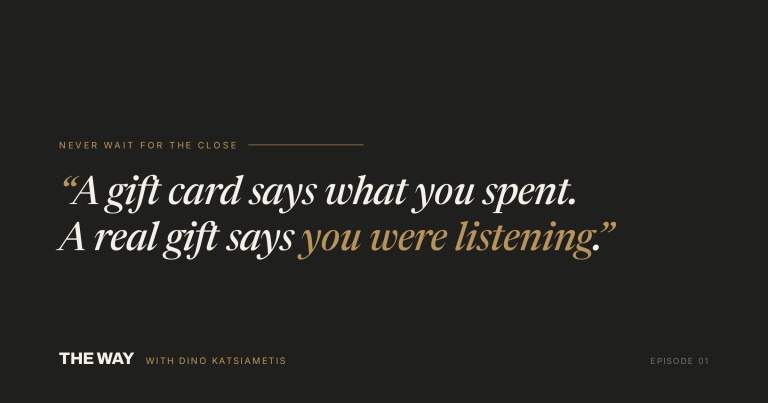
That’s the whole thing, really. A gift card says what you spent. A real gift says you were listening.
Get the Full Playbook
I turned this conversation into a full playbook: all six plays with scripts, the Open House Content Hack word-for-word, the hook fix, and the AI search checklist — built so you can run the first play this week.
Download Never Wait for the Close Playbook →
And listen to my full conversation with Drew Gillett on Episode 61 of The Way.
Who can we serve today?
#WhoCanWeServeToday
The complete system — every gift, every phase, the whole first year — is in the playbook that goes with this episode.
Never Wait for the Close · S2E01 with Dave Savage DinoKatsiametis.com/podcast/s2e01-dino-katsiametis/
Continue using AI Cursor?Keep it onTurn Off