Why I Get More Done Before Vacation Than Any Other Week of the Year

Every time I’m about to leave for vacation, the same thing happens.
I somehow:
- Catch up on everything I was behind on
- Make decisions I’d been avoiding
- And even get a week’s worth of future work done before I leave
It’s almost comical how productive that week is.
And every time, I catch myself thinking the same thing:
Why don’t I operate like this all the time?
The answer is simple.
And uncomfortable.
Parkinson’s Law Explains It
Parkinson’s Law states:
Work expands to fill the time available for its completion.
When I’m leaving town, time becomes scarce. And when time is scarce, clarity shows up.
There’s no room for:
- Busywork
- Overthinking
- Multitasking
- Meetings that feel productive but move nothing
Decisions get made.
Execution sharpens.
Not because I’m working harder — but because the container got smaller.
Multitasking Is a Lie We Tell Ourselves
When time feels abundant, multitasking sneaks in.
We convince ourselves we’re being efficient by doing five things at once. In reality, we’re just switching contexts and avoiding the hard stuff.
Multitasking doesn’t speed things up.
It slows everything down.
When I’m operating under real constraints, multitasking disappears. Not intentionally — it just becomes impossible.
And that’s the point.
This Is the Science of Scaling
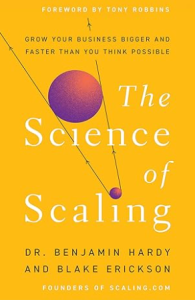
This idea shows up clearly in The Science of Scaling by Benjamin Hardy and Blake Erickson.
Growth doesn’t come from doing more things.
It comes from doing fewer things that matter more.
As people and companies scale, they often confuse activity with progress. Time expands, teams expand, and work stretches to fill the space — exactly what Parkinson’s Law predicts.
That’s when speed turns into drag.
How I Pull Myself Back When I Start Slipping
I don’t live in this mode perfectly. No one does.
But when I feel myself drifting — doing too much, focusing on the wrong things, letting small tasks crowd out big ones — I know how to bring myself back.
JAM Sessions
JAM stands for Just Another Million.
If it doesn’t meaningfully move the needle, it doesn’t belong on my calendar.
Not “nice to have.”
Not “this might help someday.”
Only work that actually matters.
Win by Noon
This concept came from Todd Bookspan, and it’s been a powerful reset for me.
The rule is simple: by noon, the most important work of the day is already done.
Not emails.
Not cleanup.
The big rocks.
Once you win by noon, the rest of the day becomes margin instead of pressure.
I Create Artificial Constraints
This one surprises people, but it works.
I intentionally book commitments that cost me money if I don’t show up:
- Golf lessons
- Infrared sauna sessions
- Fixed appointments I can’t casually cancel
Why?
Because it forces focus.
It recreates the urgency of leaving for vacation — even when I’m not going anywhere.
Big Rocks First. Small Rocks Delegated.
It really boils down to this:
Move the big rocks.
Let someone else move the small rocks.
When I fall off track, it’s almost always because I’m doing work I can do instead of work I should do.
That’s not a motivation issue.
That’s a systems issue.
Systems Are What Keep You Honest
Knowing all of this doesn’t make you immune.
Systems exist to protect you from yourself — especially when things are going well and urgency fades.
Without structure:
- Multitasking creeps back in
- Calendars fill up
- Focus erodes
Parkinson’s Law doesn’t disappear.
It just waits.
Final Thought
The reason you’re so productive before vacation isn’t discipline.
It’s constraints.
Parkinson’s Law explains why urgency sharpens execution.
The Science of Scaling explains why doing less creates more.
If you want to scale — personally or professionally — stop adding capacity.
Narrow the container.
Kill multitasking.
Move the big rocks first.
And let systems do the heavy lifting when motivation runs out.
📘 Recommended Reading
The Science of Scaling by Benjamin Hardy and Blake Erickson is one of the clearest explanations I’ve read on why growth creates drag — and how to avoid it.